Dieting has become so common that skipping meals, counting calories, avoiding certain foods, or repeatedly trying to lose weight can seem completely normal. But when does dieting stop being a lifestyle choice and become something more concerning? The answer is not simply how much someone eats, how much weight they lose, or what their body looks like.
The bigger question is what is happening around the food. In this blog, we’ll explain what chronic dieting looks like, what defines an eating disorder, and most importantly, where the line between the two can become harder to see. We’ll look at warning signs, the role of thoughts and behaviors, when professional help is needed, and how Weiss Wellness can support someone whose relationship with food has become increasingly difficult.
What Does Chronic Dieting Actually Look Like?
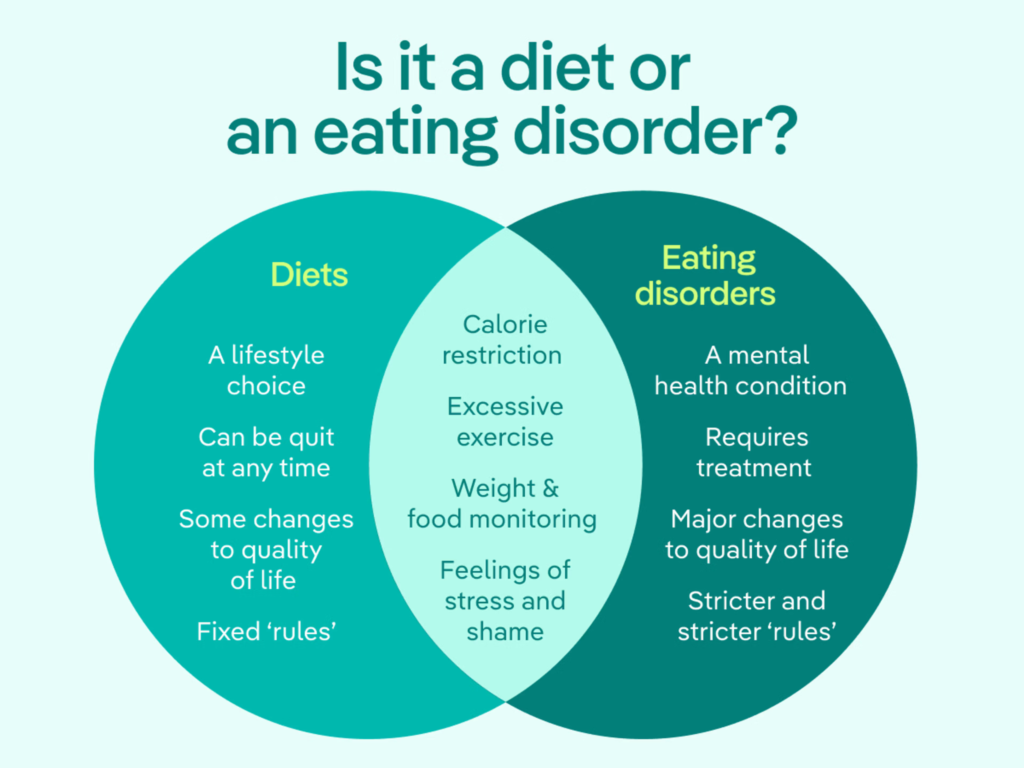
Chronic dieting means repeatedly trying to control food intake or body weight over a long period. It is not a formal eating-disorder diagnosis, but it can involve increasingly rigid rules around food.
Someone might move from one diet to another, constantly trying to “start over” after eating something they consider unhealthy. The pattern can become a regular part of everyday life.
Chronic dieting can show up in several different ways. Looking at the eating rules, behaviors, and emotional pressure involved can help make the pattern easier to recognize.
Chronic dieting often involves repeated food restriction
A person who chronically diets may spend a lot of time thinking about what they should or should not eat.
Their rules might include:
- Avoiding carbohydrates or fats
- Skipping meals to save calories
- Counting calories or tracking every food
- Having strict “good” and “bad” food categories
- Following repeated short-term diets
- Cutting out entire food groups
- Frequently weighing themselves
- Exercising specifically to compensate for eating
Not everyone who follows a structured eating plan is chronically dieting. The important factor is whether food control has become a persistent source of mental and emotional pressure.
Dieting can create a cycle of restriction
Chronic dieting often follows an all-or-nothing pattern.
Someone might decide to follow a strict plan on Monday. By Wednesday, they eat something outside the rules. They then feel that they have “failed,” eat more than they intended, and promise to restart the diet the next day.
This can create a repeating cycle:
Restriction → hunger or deprivation → eating outside the rules → guilt → stricter restriction
The cycle can continue even when the person genuinely wants to stop dieting.
The emotional side matters just as much
Two people can follow the same diet while having very different experiences.
One person might make temporary changes to their eating for a specific reason and remain flexible when plans change. Another might feel intense guilt after eating a food that was not part of their plan.
That difference matters.
As food rules begin affecting mood, relationships, social activities, or everyday decisions, it becomes more important to look beyond the diet itself.
This brings us to the other side of the comparison: what actually makes an eating disorder different?
What Makes An Eating Disorder Different From Dieting?
An eating disorder is a serious mental health condition involving significant disturbances in eating behavior, thoughts, and attitudes toward food, weight, or body shape. It is much more than following a diet.
Eating disorders can affect people of any body size. Someone does not need to look extremely thin, have a certain weight, or appear physically unwell to be struggling with one.
Eating disorders involve more than food rules
An eating disorder may involve restriction, binge eating, purging, compulsive exercise, or other behaviors used to control food, weight, or shape.
There can also be intense psychological distress around eating.
For example, someone might:
- Feel extreme fear about gaining weight
- Experience loss of control while eating
- Feel intense shame after eating
- Avoid eating around other people
- Hide food-related behaviors
- Become increasingly preoccupied with food or body shape
- Use fasting, purging, or excessive exercise after eating
- Organize daily life around food or exercise
These behaviors can occur in different eating disorders and do not form a diagnosis by themselves.
Eating disorders can seriously affect daily life
One of the clearest differences is the amount of space food and body concerns begin taking up.
Someone might stop going out because they cannot control what food will be served. They might avoid meals with friends, spend hours planning food, or become unable to exercise less even when sick or exhausted.
Work, school, relationships, concentration, sleep, and emotional wellbeing can all be affected.
The person’s world can gradually become smaller as food rules become more important.
Eating disorders can occur at any body size
Appearance cannot tell you whether someone has an eating disorder.
A person can have a serious eating disorder while appearing to be at an average or higher body weight. NIMH specifically notes that eating disorders can affect people across body weights and that someone can appear healthy while still being seriously ill.
This is particularly important when someone has lost a significant amount of weight but remains within a socially accepted weight range. A condition such as atypical anorexia can involve significant anorexia symptoms without the person being underweight.
So, looking at weight alone cannot tell us where the line is.
Where Is The Line Between Dieting And Disorder?
This is the most important part of the conversation. There is no single calorie number, weight change, or number of dieting days that suddenly turns dieting into an eating disorder.
Instead, the line becomes concerning when food and body-control behaviors become increasingly rigid, distressing, compulsive, or disruptive.
There is no single rule that separates dieting from disordered eating. Instead, several patterns can help show when food and weight concerns are becoming more rigid, distressing, or disruptive.
Rigidity can show when dieting becomes concerning
Flexibility is an important distinction.
Someone following a temporary eating plan might change their plans when they go to a friend’s birthday dinner. Someone with increasingly rigid eating patterns might feel unable to do so because breaking the rule creates intense anxiety.
One useful distinction is how a person responds when their eating plan changes.
More flexible pattern:
“I usually follow this plan, but tonight I’m going out with friends.”
More concerning pattern:
“I can’t eat anything unless I know exactly how many calories it contains.”
The difference is not whether someone follows food rules. It is how much control those rules have over them.
Distress can reveal when food control becomes harmful
Another important distinction is the emotional response when eating rules cannot be followed.
Some people can deviate from a diet without significant distress. Others experience intense guilt, anxiety, shame, or fear.
Warning signs include:
- Feeling guilty after eating ordinary foods
- Feeling anxious when meals are unpredictable
- Believing one meal has “ruined” the entire day
- Feeling the need to compensate after eating
- Becoming increasingly afraid of certain foods
- Feeling unable to relax around meals
When emotional distress starts driving food decisions, the issue deserves closer attention.
Compensation can signal a more serious pattern
Compensation means trying to “make up” for eating.
This might involve fasting, severely restricting the next meal, exercising excessively, vomiting, or using other methods to counteract food intake.
For example:
“I ate dessert, so I need to skip breakfast tomorrow.”
This is different from simply deciding to eat differently the following day. The important factor is the belief that food must be paid back or erased.
Compensatory behaviors can be warning signs of an eating disorder and are worth taking seriously.
Preoccupation can show when food takes over
Another useful question is:
How much of your day is spent thinking about food, weight, or exercise?
Someone might spend occasional time planning meals. A more concerning pattern can involve constantly calculating, checking, researching, worrying, or mentally negotiating around food.
NEDA describes preoccupation with food, body, and exercise that affects quality of life as a form of disordered eating.
When food thoughts begin taking up significant mental space, the concern is no longer simply about following a diet.
The line, therefore, is less about the diet itself and more about the relationship someone has developed with food, their body, and the rules they are following.
How Can You Tell Which Pattern Applies?
It can be difficult to recognize a problem when restrictive behaviors have become normalized. Looking at several areas together can make the difference easier to understand.
The following comparison is not a diagnostic test. It is a way to think about the patterns behind the behavior.
Flexibility and emotional response reveal important differences
| Area | More flexible dieting | More concerning pattern |
| Food rules | Can change when circumstances change | Rules feel rigid or impossible to break |
| Eating out | Can adapt to available choices | Avoids situations with unfamiliar food |
| Food choices | Preferences guide decisions | Fear or guilt controls decisions |
| Weight changes | Not the sole measure of success | Weight strongly influences self-worth |
| Exercise | Can rest when needed | Feels compelled to exercise or compensate |
| Eating mistakes | Seen as normal | Create intense guilt or panic |
| Social life | Meals remain part of life | Food rules interfere with relationships |
| Thoughts | Food takes a reasonable amount of attention | Food, weight, or exercise dominate the day |
| Control | Person feels in control of the plan | The rules begin controlling the person |
The important point is that this table describes patterns, not diagnoses. A person can have concerning behaviors without meeting criteria for a specific eating disorder, and a professional assessment is needed to determine what is happening.
The intention behind dieting also deserves attention
The reasons behind dieting and the meaning a person attaches to it can also provide useful context.
Wanting to change eating habits does not automatically indicate an eating disorder. But dieting can become more concerning when weight loss or food control becomes tied closely to self-worth, fear, or a need to feel safe.
A person might begin with:
“I want to eat differently.”
Over time, that can become:
“I feel like I’m only doing well when I’m eating perfectly.”
That shift in meaning can be more important than the original diet itself.
Daily life can show when the pattern escalates
Look at what is happening outside mealtimes.
Has the person stopped accepting invitations because they cannot control the menu? Are they constantly checking their body? Are they exercising despite exhaustion? Are relationships becoming difficult because of food rules?
When eating concerns begin interfering with normal life, it is worth taking them seriously.
These differences help explain why chronic dieting should not automatically be labelled an eating disorder, while also showing why persistent dieting patterns should not always be dismissed as harmless.
When Should You Consider Professional Help?
You do not need to wait for a formal diagnosis before asking for help. Early support can be useful when eating behaviors are becoming increasingly rigid, distressing, or difficult to control.
A professional can look at the full picture rather than focusing on weight or one isolated behavior.
Certain behaviors deserve closer professional attention
Consider reaching out to a qualified professional if you notice:
- Repeated restriction or skipped meals
- Frequent binge episodes or feeling unable to stop eating
- Purging after eating
- Excessive or compulsive exercise
- Increasing fear of particular foods
- Frequent body checking or weighing
- Significant social withdrawal around food
- Intense guilt after eating
- Constant thoughts about food, weight, or exercise
- Increasing secrecy around eating behaviors
These signs do not automatically establish an eating-disorder diagnosis. They indicate that the relationship with food may deserve professional attention.
Physical changes should not be dismissed
Eating disorders can affect physical health as well as emotional wellbeing.
Possible physical warning signs include dizziness, fainting, weakness, gastrointestinal problems, menstrual changes, feeling unusually cold, difficulty concentrating, or other noticeable changes in health.
Someone experiencing these symptoms should not assume they are simply the result of dieting and may benefit from medical evaluation.
Medical assessment can be important, particularly when restriction, purging, or significant changes in eating have been occurring.
Getting help early can prevent deeper patterns
People often delay getting help because they think their behavior is “not bad enough.”
They may compare themselves with someone who has a more visible eating disorder and decide their own concerns do not count.
That comparison can be misleading.
Eating disorders exist on a spectrum of presentations, and not everyone experiences the same symptoms. Early professional support may help someone understand their behaviors before they become more difficult to change.
Once the concern has been recognized, the next step is understanding what effective support can look like.
How Weiss Wellness Can Help With Disordered Eating
Weiss Wellness provides personalized psychotherapy for teens, adults, and families, including support for eating disorders and related concerns. Its approach can address the emotional and psychological factors that may influence a person’s relationship with food and their body.
Therapy can explore what drives food behaviors
A food rule rarely exists in isolation.
For one person, restriction may be connected with anxiety. For another, it may be tied to perfectionism, body dissatisfaction, stress, or a need for control.
Therapy can help uncover these patterns instead of focusing only on what someone is eating.
At Weiss Wellness, eating-disorder therapy can address thoughts and behaviors around food while working alongside dietitians and physicians when additional nutritional or medical support is needed.
Treatment can address underlying emotional concerns
Sometimes changing the eating behavior is only part of the work.
Someone may also need help with:
- Anxiety or depression
- Body-image concerns
- Perfectionism
- Difficult emotions
- Trauma-related experiences
- Family or relationship concerns
- Major life transitions
- Unhelpful coping patterns
Addressing these areas may support broader recovery and wellbeing.
Personalized therapy can support lasting recovery
There is no single experience of chronic dieting or disordered eating.
That is why therapy should consider the person’s individual history, symptoms, relationships, emotional needs, and goals.
Weiss Wellness offers psychotherapy for teens, adults, and families and can provide both in-person and virtual care. For someone who feels increasingly controlled by food rules, therapy can provide a space to understand what is happening without shame and determine what kind of support is appropriate.
The goal is not simply to stop dieting. It is to develop a healthier relationship with food, body, emotions, and everyday life.
Final Thoughts
Chronic dieting and eating disorders are not automatically the same thing, but the difference deserves attention. The clearest warning signs are often found in the relationship with food rather than the diet itself.
When rules become rigid, guilt becomes intense, compensation becomes routine, or food and body concerns begin controlling everyday life, the concern may extend beyond ordinary dieting.
An eating disorder can affect anyone, regardless of body size or appearance.
If your relationship with food has become stressful, restrictive, or difficult to control, professional support can help. Weiss Wellness offers personalized therapy to explore these patterns and build healthier ways of coping. Reach out to begin that conversation with compassionate, individualized support.
Frequently Asked Questions
Can healthy eating become unhealthy without an eating disorder?
Yes. Someone can develop a stressful or restrictive relationship with food without meeting criteria for a diagnosed eating disorder. This is still worth addressing, especially if the pattern causes anxiety, guilt, social difficulties, or reduced quality of life.
Can someone have an eating disorder without losing weight?
Absolutely. Eating disorders occur across body sizes. Weight loss is not required for every diagnosis, and some people experience serious symptoms while maintaining, gaining, or remaining within a higher weight range.
Does wanting to lose weight mean someone has an eating disorder?
No. Wanting to change body weight does not by itself indicate an eating disorder. The concern arises when weight control becomes increasingly rigid, distressing, compulsive, or begins interfering with physical health and everyday functioning.
Can a doctor diagnose an eating disorder?
A physician can identify concerning symptoms and evaluate physical health, but eating-disorder diagnosis may involve different qualified professionals depending on the situation. Assessment generally considers eating behaviors, thoughts, emotional symptoms, medical effects, and daily functioning.
Can someone recover while still caring about their weight?
Recovery does not require having zero thoughts about weight. Treatment can involve developing a relationship with food and the body that is less dominated by fear, rules, guilt, or compulsive behaviors.
Can chronic dieting affect relationships?
It can. Strict food rules may make restaurants, celebrations, travel, or shared meals stressful. Someone might decline invitations, need to control menus, or feel uncomfortable eating around others, gradually reducing opportunities for connection.
What should I say to someone I am worried about?
Focus on what you have noticed rather than commenting on their weight or appearance. You might say, “I’ve noticed that food seems to be causing you a lot of stress lately. How are you doing?” This creates space for conversation without judgment.
Is stopping dieting enough to recover from an eating disorder?
Not necessarily. An eating disorder can involve deeply established thoughts, emotions, and behaviors that need professional treatment. Simply removing a diet may not address fear of food, bingeing, purging, compulsive exercise, or underlying emotional concerns.